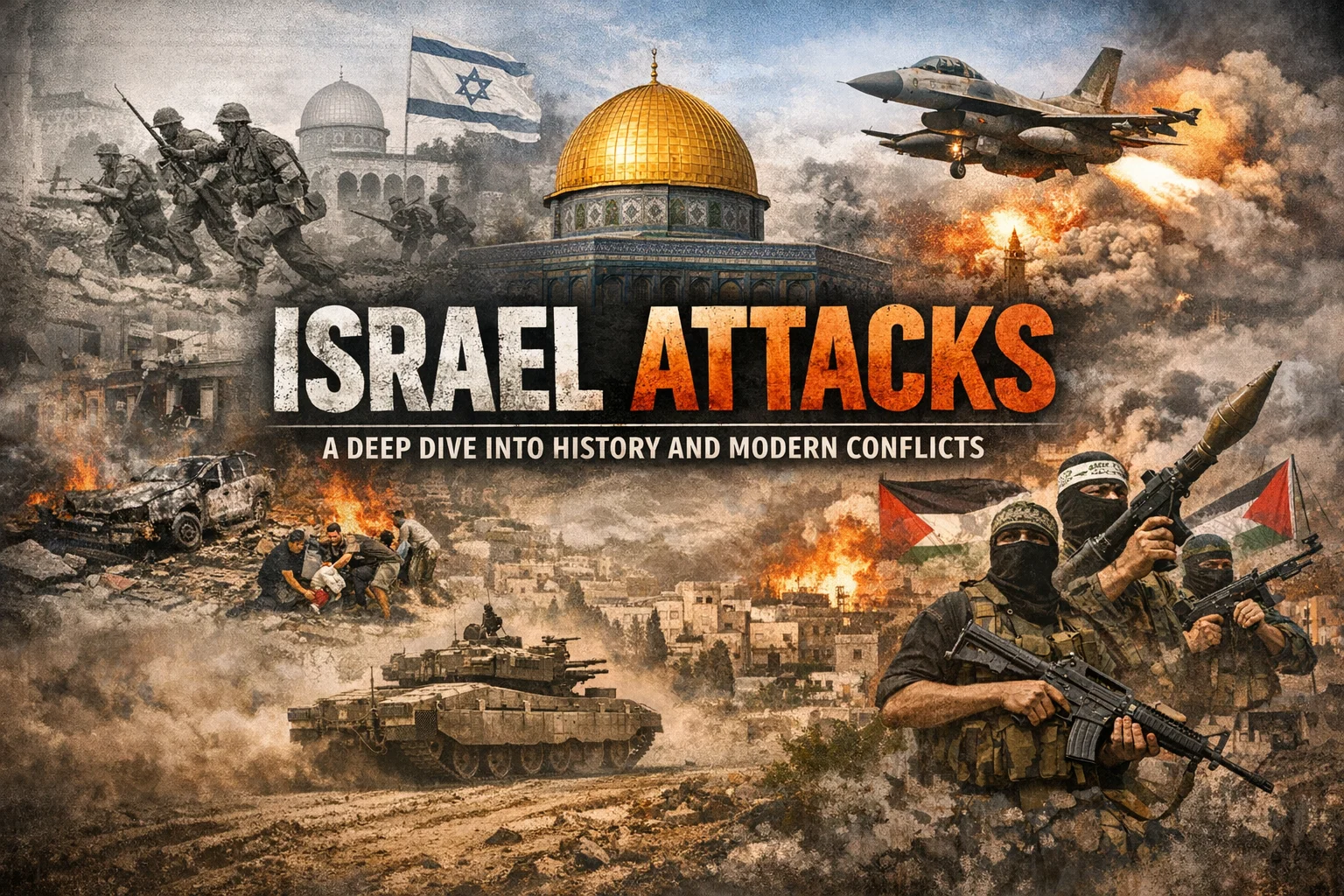
When we talk about Israel attacks, it’s impossible to ignore the layered history that has shaped the Middle East for decades. Israel, a nation born out of conflict and resilience, has been involved in numerous military actions often framed as defensive measures against threats to its security. These Israel attacks range from preemptive strikes to full-scale invasions, each leaving a mark on regional politics, economies, and human lives. Understanding them requires looking beyond headlines to the root causes, strategies, and consequences that continue to influence global affairs today.
The term “Israel attacks” often sparks heated debates, with perspectives varying based on where you stand geographically or ideologically. For many, these actions represent necessary self-defense in a hostile neighborhood; for others, they symbolize aggression and occupation. This article aims to unpack it all in a straightforward way, drawing on historical facts and recent developments to give you a balanced, engaging read. We’ll explore how these events unfolded, why they happened, and what they mean for the future, all while keeping things casual yet informed.
The Origins of Israel Attacks: From Independence to Early Wars
The story of Israel attacks begins right at the nation’s founding in 1948, amid the chaos of the Arab-Israeli War. What started as a declaration of independence quickly escalated into a full-blown conflict when neighboring Arab states invaded the newly formed country. Israel, with its fledgling defense forces, launched counteroffensives that not only repelled the invaders but also expanded its territory. These early Israel attacks were characterized by guerrilla tactics and rapid mobilizations, setting a precedent for the Israeli Defense Forces’ (IDF) emphasis on speed and innovation.
In those initial years, Israel attacks were often reactive, responding to blockades and border skirmishes. For instance, the 1956 Suez Crisis saw Israel team up with Britain and France in a coordinated assault on Egypt to secure the Sinai Peninsula and reopen vital waterways. Though the operation achieved short-term gains, international pressure forced a withdrawal, highlighting how global powers have always played a role in moderating or escalating these conflicts. This period taught Israel the value of alliances and the risks of overreach, lessons that echo in today’s strategies.
Key Milestones in Israel Attacks During the Cold War Era
Jumping ahead to the 1960s and 1970s, Israel attacks took on a more preemptive flavor, epitomized by the Six-Day War in 1967. Facing mounting threats from Egypt, Jordan, and Syria, Israel launched surprise airstrikes that decimated enemy air forces on the ground. This bold move, often cited as one of the most efficient Israel attacks in history, led to the capture of the Sinai Peninsula, Gaza Strip, West Bank, and Golan Heights. The war reshaped the map and boosted Israel’s military reputation, but it also sowed seeds for ongoing disputes over occupied territories.
The Yom Kippur War of 1973 flipped the script, with Egypt and Syria initiating surprise attacks on Israel during a holy day. Israel’s response involved fierce counteroffensives, pushing back invaders and even threatening Damascus and Cairo. These Israel attacks demonstrated the IDF’s adaptability, incorporating lessons from previous conflicts like improved intelligence and armored warfare. However, the high casualties on all sides led to a reevaluation of military doctrines, paving the way for peace treaties like the one with Egypt in 1979. It’s fascinating how these events not only altered borders but also influenced superpower dynamics during the Cold War.
Israel Attacks in Lebanon: Invasions and Border Clashes
Shifting focus to Lebanon, Israel attacks there have been a recurring theme since the late 1970s. The 1978 Operation Litani was Israel’s first major incursion, aimed at pushing Palestinian militants away from the border after repeated rocket attacks. Israeli forces swept into southern Lebanon, establishing a buffer zone, but the operation highlighted the challenges of occupying foreign soil, with guerrilla warfare draining resources and morale.
The 1982 Lebanon War, known as Operation Peace for Galilee, marked a more ambitious phase of Israel attacks. Triggered by an assassination attempt on an Israeli ambassador, the IDF invaded to dismantle PLO bases. They advanced to Beirut, leading to the expulsion of Palestinian fighters but also tragic events like the Sabra and Shatila massacres, where allied militias committed atrocities under Israeli oversight. This conflict evolved into a prolonged occupation until 2000, fostering the rise of Hezbollah and setting the stage for future skirmishes. It’s a reminder that Israel attacks, while tactically successful, often create new adversaries in the long run.
The Intifadas and Israel Attacks on Palestinian Territories
The Palestinian uprisings, or Intifadas, brought Israel attacks into urban settings, blending military operations with crowd control. The First Intifada (1987-1993) saw widespread protests met with Israeli crackdowns, including targeted strikes on militant leaders. These Israel attacks shifted from large-scale battles to precision operations, using intelligence to disrupt networks without full invasions.
The Second Intifada (2000-2005) intensified things, with suicide bombings prompting Israel attacks like Operation Defensive Shield in 2002. The IDF reoccupied West Bank cities to root out terrorists, leading to high civilian casualties and international criticism. This era introduced tactics like barrier construction and drone surveillance, which have become staples in modern Israel attacks. Reflecting on it, these periods underscore the human cost of prolonged conflict, where security measures often exacerbate tensions rather than resolve them.
Gaza Conflicts: A Series of Escalating Israel Attacks
Gaza has been a hotspot for Israel attacks since Israel’s withdrawal in 2005, ironically leading to more confrontations. Operation Cast Lead in 2008-2009 was a response to rocket fire from Hamas, involving airstrikes and ground incursions that devastated Gaza’s infrastructure. Israel claimed it targeted militant sites, but the high death toll—over 1,400 Palestinians—drew global condemnation for disproportionate force.
Subsequent rounds, like Operation Pillar of Defense in 2012 and Protective Edge in 2014, followed similar patterns: rocket barrages met with overwhelming Israel attacks. In 2014, the IDF destroyed tunnels and launched thousands of strikes, aiming to degrade Hamas’ capabilities. These operations highlight Israel’s “mowing the lawn” strategy—periodic interventions to weaken threats without permanent occupation. Yet, each cycle rebuilds resentment, making lasting peace elusive. It’s like a grim loop where short-term security gains come at the expense of long-term stability.
| Timeline of Major Israel Attacks and Operations | ||
|---|---|---|
| Year | Operation/War | Key Details |
| 1948 | Arab-Israeli War | Counteroffensives against invading Arab states; territorial expansion. |
| 1956 | Suez Crisis | Invasion of Sinai with allies; withdrawal under pressure. |
| 1967 | Six-Day War | Preemptive strikes; capture of Sinai, Gaza, West Bank, Golan. |
| 1973 | Yom Kippur War | Counterattacks against Egypt and Syria; near-victory. |
| 1978 | Operation Litani | Invasion of southern Lebanon; PLO expulsion. |
| 1982 | Lebanon War | Advance to Beirut; PLO ousted, but Hezbollah emerges. |
| 2008-2009 | Operation Cast Lead | Gaza incursion; response to rockets. |
| 2014 | Operation Protective Edge | Tunnel destruction; heavy airstrikes. |
| 2023-ongoing | Gaza War | Invasion after October 7 attacks; ongoing humanitarian crisis. |
| 2024-2025 | Conflicts with Hezbollah and Iran | Invasions and strikes; ceasefire in 2025. |
This table captures the essence of pivotal Israel attacks, showing a pattern of escalation and adaptation over time.
Recent Israel Attacks: The 2023 Gaza War and Beyond
Fast-forward to the 2023 Gaza War, ignited by Hamas’ October 7 attacks that killed over 1,200 Israelis. Israel’s response was swift and massive, with airstrikes and a ground invasion dubbed Operation Iron Swords. These Israel attacks have leveled much of Gaza, resulting in over 71,000 Palestinian deaths by early 2026, according to reports. The IDF targeted Hamas tunnels and leaders, but the blockade and bombings created a famine and displacement crisis, drawing UN accusations of war crimes.
As the conflict dragged on, Israel attacks expanded. In 2024, operations against Hezbollah in Lebanon involved invasions and airstrikes, weakening the group but risking broader war. Then came the 2025 Iran-Israel clash, where Israel, with U.S. backing, struck Iranian nuclear sites in June. Iran retaliated with missiles, but a ceasefire held. Recent strikes in Gaza, even during truces, like the January 2026 airstrikes killing 32, show how fragile peace is. “We strike only in self-defense,” an Israeli official once said, echoing a common narrative amid ongoing violations.
Israel Attacks on Iran: A New Front in Regional Tensions
The escalation with Iran marks a bold chapter in Israel attacks. In April 2024, Israel hit an Iranian consulate in Syria, killing generals and prompting Iran’s first direct missile barrage on Israel. Israel countered with strikes on Iranian facilities. By June 2025, amid nuclear talks, Israel launched Operation Rising Lion, bombing sites with U.S. help. This prevented Iran from going nuclear, per claims, but set back its program only months.
Iran’s response included proxy attacks via Houthis and Hezbollah, but Israel’s precision strikes dismantled key assets. Quotes from leaders highlight the stakes: Israeli PM Netanyahu called it “a last-resort to prevent catastrophe,” while Iran’s Foreign Minister labeled it “an act of war.” These Israel attacks underscore the shift from covert ops to open confrontation, fueled by nuclear fears and regional rivalries.
The Role of Technology in Modern Israel Attacks
Technology has revolutionized Israel attacks, turning the IDF into a high-tech powerhouse. Drones, like those used in Gaza for surveillance and strikes, allow precision with minimal ground risk. The Iron Dome system intercepts rockets, saving lives during barrages from Hamas or Hezbollah. In recent operations, AI-driven targeting has been key, though criticized for civilian casualties.
Cyber warfare adds another layer; Israel attacks often include hacks disrupting enemy communications, as seen in operations against Iran. “Our tech edge is our survival,” a former IDF chief noted, capturing how innovation compensates for Israel’s small size. But this reliance raises ethical questions—does it make warfare too detached? Engaging with these tools shows Israel’s adaptation to asymmetric threats, blending old-school tactics with cutting-edge gear.
Global Reactions to Israel Attacks: Allies and Critics
Israel attacks rarely stay isolated; they ripple globally. The U.S. has been a steadfast ally, providing aid and vetoing UN resolutions critical of Israel. In the 2025 Iran strikes, U.S. involvement marked a direct escalation, with Trump praising it as necessary. European nations often call for restraint, while Arab states like Saudi Arabia have normalized ties via Abraham Accords, viewing Iran as a mutual threat.
Critics, including human rights groups, decry Israel attacks for disproportionate force. Protests worldwide highlight Palestinian suffering, with boycotts and divestments gaining traction. “The world watches, but action lags,” a UN official quipped. This divide fuels debates on international law, where Israel argues self-defense under Article 51 of the UN Charter, but others see violations of proportionality.
Humanitarian Impacts of Israel Attacks
No discussion of Israel attacks is complete without addressing the human toll. In Gaza, repeated strikes have displaced millions, with infrastructure in ruins. The 2023-2026 war alone caused a famine, per aid groups, with children bearing the brunt. Lebanon invasions displaced communities, creating refugee crises that strain neighbors like Jordan.
On the Israeli side, attacks prompt evacuations and psychological trauma from constant alerts. Economically, these conflicts cost billions, diverting funds from development. “War’s true victims are the innocents,” a Palestinian activist said, a sentiment echoed across divides. Rebuilding efforts, often hampered by blockades, highlight the need for sustainable peace over military solutions.
Strategic Analysis: Why Israel Attacks Persist
Why do Israel attacks continue? Security threats from groups like Hamas and Hezbollah, backed by Iran, drive a doctrine of deterrence. Preemptive strikes aim to neutralize dangers before they materialize, as in the Six-Day War. Internal politics play a role; hardline governments rally support through tough actions.
Yet, critics argue these Israel attacks perpetuate a cycle of violence, empowering extremists on all sides. Alternatives like diplomacy have worked—Egypt and Jordan peace treaties prove it—but trust deficits hinder progress. Analyzing this, it’s clear that without addressing root issues like occupation and statehood, the pattern will endure.
The Future of Israel Attacks in a Changing World
Looking ahead, Israel attacks may evolve with emerging threats. Climate change could exacerbate resource conflicts, while cyber domains open new battlefields. Normalization with more Arab states might reduce fronts, but Iran’s nuclear ambitions loom large.
Optimists point to ceasefires, like the 2025 Iran truce, as steps forward. “Peace is possible if we choose it,” a diplomat noted. For readers, understanding these dynamics empowers informed opinions, fostering dialogue over division.
Conclusion
In wrapping up this exploration of Israel attacks, it’s evident that these events are more than military maneuvers—they’re threads in a complex tapestry of history, survival, and aspiration. From the 1948 war to recent Gaza strikes, Israel has navigated existential threats with a mix of innovation and controversy. While achieving security, the costs in lives and stability are profound, urging a path toward negotiation. As the region shifts, perhaps the next chapter will prioritize peace over conflict, benefiting all involved.
FAQ
What Are the Most Notable Israel Attacks in History?
The most notable Israel attacks include the 1967 Six-Day War, where preemptive strikes led to major territorial gains, and the 1982 Lebanon invasion aimed at expelling militants. These operations shaped Israel’s military doctrine, emphasizing speed and intelligence. More recently, the 2023 Gaza War involved extensive airstrikes and invasions, responding to Hamas attacks but causing widespread destruction.
Each of these Israel attacks has had lasting impacts, from redrawing borders to influencing international relations. Understanding them helps grasp the ongoing tensions in the Middle East.
Why Do Israel Attacks Often Target Gaza?
Israel attacks on Gaza typically stem from rocket fire and tunnel threats from groups like Hamas. For example, operations like Protective Edge in 2014 focused on destroying militant infrastructure. The dense population makes these strikes controversial, often leading to high civilian casualties.
Strategically, Israel views these as defensive, but critics argue they exacerbate the humanitarian crisis. The cycle continues due to unresolved political issues.
How Have Israel Attacks Affected Regional Stability?
Israel attacks have both stabilized and destabilized the region. Strikes against Iran in 2025 prevented nuclear escalation but heightened proxy wars. In Lebanon, invasions weakened Hezbollah but fostered resentment.
Overall, they contribute to a volatile environment, with alliances shifting and economies suffering. Peace deals like the Abraham Accords offer hope for de-escalation.
What Role Does the U.S. Play in Israel Attacks?
The U.S. provides military aid and diplomatic support for many Israel attacks, as seen in the 2025 Iran operations where American forces joined strikes. This alliance stems from shared security interests.
However, it draws criticism for enabling actions seen as aggressive. U.S. involvement often influences ceasefires and negotiations.
Are There Alternatives to Israel Attacks for Security?
Alternatives to Israel attacks include diplomacy, economic incentives, and intelligence sharing. Peace treaties with Egypt and Jordan show success without ongoing military action. Building trust through dialogue could reduce the need for strikes.
Yet, immediate threats often prioritize military responses. Long-term, addressing grievances like occupation might break the cycle.
How Do Israel Attacks Impact Civilians?
Israel attacks frequently result in civilian casualties, as in recent Gaza strikes killing dozens despite ceasefires. Displacement and infrastructure damage create humanitarian crises, with famine risks in besieged areas.
On the Israeli side, incoming attacks cause trauma and evacuations. Minimizing harm requires better targeting and international oversight.