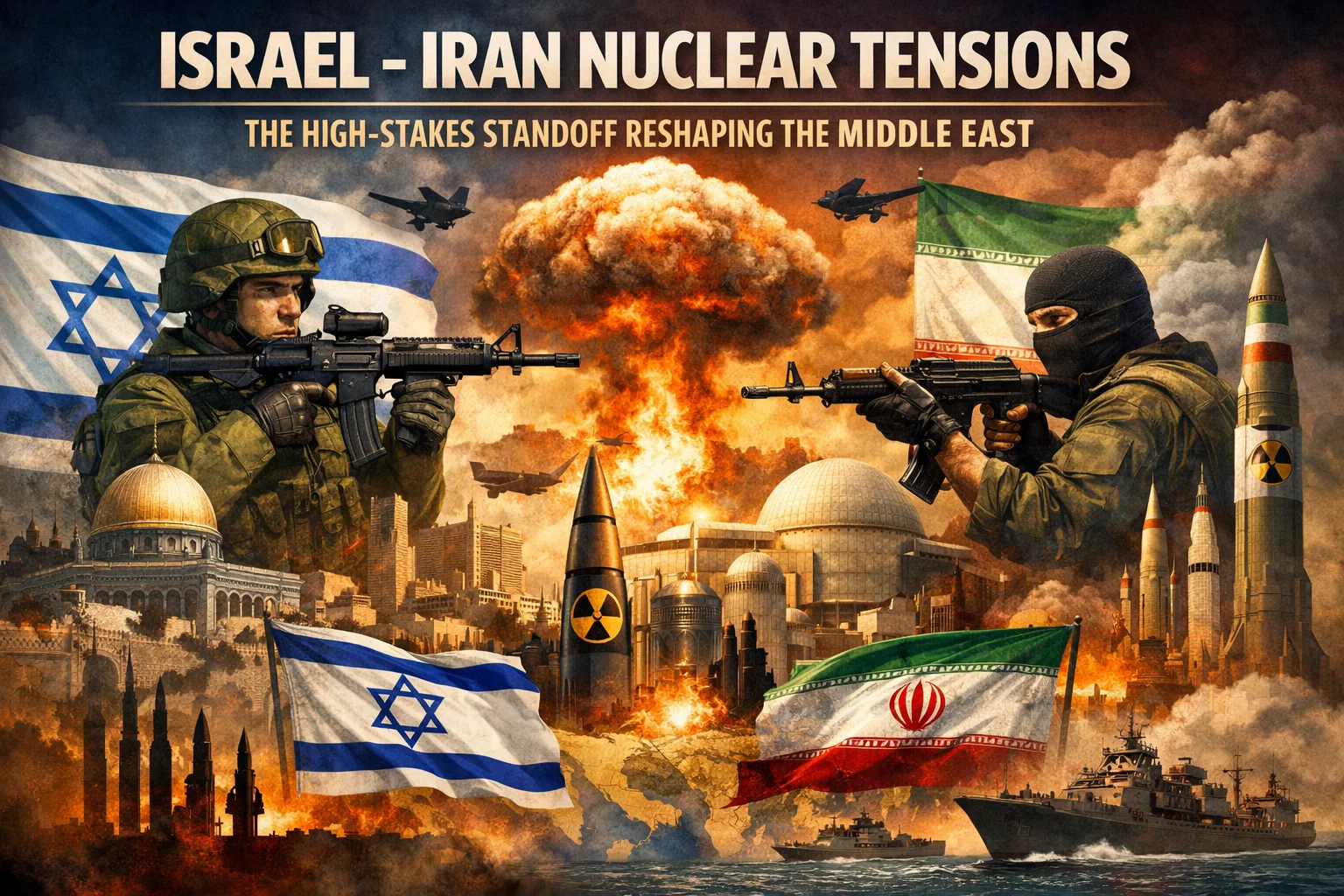
The Israel Iran nuclear issue sits at the heart of one of the world’s most volatile geopolitical flashpoints, where decades of mistrust, technological rivalry, and military posturing could tip the balance toward catastrophe or cautious diplomacy. In early 2026, with indirect talks resuming in Geneva and Oman amid fresh U.S. military buildups, the world watches nervously as both sides edge closer to another confrontation. This isn’t just about two nations squaring off—it’s a story that touches energy markets, international alliances, and the very future of nuclear non-proliferation.
You might wonder how things escalated so dramatically after the fragile ceasefire of mid-2025. The short answer: deep-seated fears on Israel’s side that Iran is racing toward a bomb, combined with Tehran’s insistence on its sovereign right to peaceful nuclear energy. Casual observers often simplify it to “bad guys versus good guys,” but the reality is far more nuanced, involving proxy conflicts, cyber sabotage, assassinations, and broken diplomatic deals. As someone following this for years, I can tell you the Israel Iran nuclear dynamic feels like a pressure cooker with the flame turned up high right now.
What makes this moment different? Recent U.S.-Iran negotiations show tiny glimmers of progress on guiding principles, yet red lines remain firm. Iran won’t accept zero enrichment, while the U.S. and Israel demand verifiable dismantlement of key capabilities. With reports of Iran quietly rebuilding at underground sites and Israel expanding its own facilities, the stakes have never been higher. This article breaks it all down in plain language, exploring the history, current realities, and possible futures without the usual jargon overload.
Tracing the Origins – How the Israel Iran Nuclear Rivalry Began
The roots of the Israel Iran nuclear standoff stretch back further than most people realize, long before the 1979 Islamic Revolution flipped Iran’s alliances upside down. Under the Shah, Iran actually pursued nuclear technology with Western blessing, viewing it as a path to modernity and energy independence. Israel, freshly independent and surrounded by hostile neighbors, saw nuclear capability as an existential insurance policy against another Holocaust. Both nations, interestingly, started with peaceful intentions on paper, but security paranoia changed everything.
Fast forward to the revolution: Ayatollah Khomeini initially shelved nuclear ambitions, calling them un-Islamic, but by the 1980s, the Iran-Iraq War convinced leaders that advanced weapons were necessary for survival. Meanwhile, Israel had already crossed the nuclear threshold in secret during the late 1960s, building the Dimona reactor with French help. This created an immediate imbalance—Israel had the ultimate deterrent while staying officially silent about it, a policy known as nuclear opacity that continues today.
Early cooperation between the two countries actually existed in the 1950s and 1960s, with Israel selling arms to the Shah’s regime and both sharing intelligence against common foes like Soviet influence. But the 1979 upheaval turned Iran into a theocratic state exporting revolution, and suddenly Israel became “the Little Satan” in Iranian rhetoric. The Israel Iran nuclear divide hardened as Tehran revived its program in the 1990s, allegedly with help from Pakistan’s A.Q. Khan network. By the early 2000s, Western intelligence began flagging undeclared Iranian sites, sparking the crisis we know today.
What really accelerated the rivalry was the combination of Iran’s missile development and Israel’s Begin Doctrine—the idea that no enemy should ever be allowed to acquire nuclear weapons. Think of it like two boxers circling each other in the ring, each convinced the other is about to throw a knockout punch. This historical mistrust explains why every Iranian centrifuge feels like a direct threat in Jerusalem, and why every Israeli strike or sabotage operation fuels paranoia in Tehran.
The 2015 Joint Comprehensive Plan of Action (JCPOA) offered a brief pause, limiting Iran’s enrichment in exchange for sanctions relief. But when the U.S. pulled out in 2018, Iran ramped up its activities, enriching uranium to ever-higher levels. By the 2020s, the Israel Iran nuclear shadow war had gone public with direct missile exchanges, setting the stage for the explosive events of 2025. Understanding this long backstory helps explain why compromise feels so elusive even now—it’s not just politics; it’s survival instincts clashing head-on.
Iran’s Nuclear Journey: Peaceful Energy or Path to the Bomb?
Iran has always maintained its nuclear program is for electricity generation and medical isotopes, pointing to fatwas from Supreme Leader Khamenei banning weapons of mass destruction. Yet international watchdogs and intelligence agencies paint a different picture, one of steadily advancing capabilities that could quickly pivot to weapons if the decision is made. The facilities at Natanz, Fordow, and Isfahan form the backbone of this program, with thousands of centrifuges spinning uranium hexafluoride gas to increase the concentration of U-235.
Before the 2025 strikes, Iran had amassed hundreds of kilograms of uranium enriched to 60 percent—alarmingly close to the 90 percent needed for bombs. Experts calculated Tehran could produce enough fissile material for a weapon in weeks if it chose to dash forward. The IAEA repeatedly flagged undeclared sites and unexplained traces of uranium at military locations, raising questions about a possible covert weapons track. Iran dismisses these as politically motivated, but the lack of full cooperation with inspectors only heightens suspicions.
Post-2025, the picture grew murkier. Israeli and U.S. bunker-buster strikes heavily damaged the three main sites during the 12-day war, setting the program back by years according to Pentagon assessments. Yet satellite imagery and intelligence suggest Iran is already rebuilding, sealing tunnels at Isfahan and accelerating work at a deeply buried facility nicknamed Pickaxe Mountain south of Natanz. That 400-plus kilograms of near-weapons-grade material? Its location remains uncertain—possibly buried under rubble or quietly relocated.
Casually speaking, it’s like Iran is playing nuclear whack-a-mole. Every time facilities get hit, engineers pop up elsewhere with better protections. The program relies on domestic know-how now, but supply chains from China for specialized parts keep it alive despite sanctions. In 2026 talks, Iran offers to dilute its stockpile in exchange for full sanctions relief and recognition of its enrichment rights. The U.S. side counters that anything short of zero enrichment leaves the door open to a bomb.
This Israel Iran nuclear puzzle involves more than hardware. It’s about intent, breakout time, and regional domino effects. If Iran goes nuclear, Saudi Arabia and others might follow, turning the Middle East into a multipolar nuclear nightmare. Tehran argues its program deters aggression, especially after seeing what happened to Libya and Iraq. Yet for Israel and the West, the combination of advanced missiles, proxy militias, and enrichment levels creates an unacceptable risk. The journey continues, with each new centrifuge installation or inspection refusal adding another layer of tension.
Israel’s Nuclear Reality: The Undeclared Powerhouse
While the spotlight stays fixed on Iran’s program, Israel’s own nuclear capabilities form the unspoken backdrop to every confrontation. Widely estimated to possess around 90 plutonium-based warheads—with enough material for up to 200 more—Israel maintains a policy of deliberate ambiguity. It never confirms or denies the arsenal, sticking to the line that it “will not be the first to introduce nuclear weapons to the Middle East.” This opacity has served it well, avoiding NPT obligations and international inspections while keeping adversaries guessing.
The heart of the program is the Shimon Peres Negev Nuclear Research Center near Dimona, a sprawling desert complex featuring a reactor and reprocessing plant built with French assistance in the late 1950s. Construction was so secretive that workers were told they were building a textile factory. By the mid-1960s, Israel had assembled its first devices, ramping up production after the 1967 war. Today, Dimona produces plutonium and likely supports enrichment activities, with recent satellite images showing major new construction that analysts believe could expand capacity or add a second reactor.
Israel’s delivery systems complete the triad: F-15 and F-35 fighter jets for air drops, Dolphin-class submarines capable of launching nuclear-tipped cruise missiles from the sea, and Jericho ballistic missiles reaching as far as 5,500 kilometers or more. This setup ensures second-strike capability even if the homeland faces overwhelming attack—the famous “Samson Option” where Israel would unleash everything in a last-ditch defense.
In the context of the Israel Iran nuclear standoff, this arsenal acts as both shield and sword. Israeli leaders view any Iranian bomb as an existential threat that could neutralize their qualitative military edge. That’s why preventive strikes have become doctrine, from the 1981 Osirak bombing in Iraq to the 2007 strike on Syria and the 2025 operations against Iran. The ambiguity allows plausible deniability while signaling to Tehran that crossing certain lines invites overwhelming response.
Critics argue Israel’s opacity undermines global non-proliferation efforts, but supporters say it’s the only realistic posture in a hostile neighborhood. Recent hints from officials—like references to “other capabilities”—test the boundaries without fully breaking the policy. As Iran rebuilds, Israel continues modernizing Dimona, ensuring its deterrent remains credible. This mutual opacity and suspicion fuel the cycle: Iran claims victimhood while advancing its program, Israel maintains silence while striking when necessary. The Israel Iran nuclear balance remains precarious precisely because one side is open about ambitions (even if denied as weapons-related) and the other stays strategically vague.
Decades of Shadow War: Covert Operations and Sabotage
Long before missiles flew openly in 2025, the Israel Iran nuclear contest played out in the shadows through cyber attacks, assassinations, and mysterious explosions. Stuxnet, the sophisticated computer worm uncovered in 2010, stands out as a masterpiece of sabotage. Widely attributed to U.S.-Israeli cooperation, it targeted Natanz centrifuges, causing them to spin out of control while reporting normal operations to operators. This delayed Iran’s program by months or years without a single shot fired—an early demonstration of how digital weapons could reshape traditional conflicts.
The campaign didn’t stop there. Between 2010 and 2022, at least five Iranian nuclear scientists were assassinated, often in sophisticated operations involving remote-controlled machine guns or motorcycle bombs. Mohsen Fakhrizadeh, considered the father of Iran’s weapons research, was killed in 2020 by a satellite-operated gun in a daring roadside ambush. Iran blamed Israel each time, vowing revenge while accelerating its program underground.
Explosions at key facilities added to the pressure. In 2021, a massive blast at Natanz destroyed a power substation, followed by another at a centrifuge assembly plant. Power blackouts, fires, and mysterious drone strikes became routine. These actions, combined with sanctions and diplomatic isolation, aimed to slow Iran’s progress without triggering full-scale war. Israel called it “mowing the grass”—periodic trimming to prevent overgrowth.
Iran responded in kind with proxy attacks through Hezbollah, Houthis, and militias in Iraq and Syria. Rocket barrages on Israeli positions, tanker seizures in the Gulf, and cyber intrusions against Israeli infrastructure created a tit-for-tat cycle. The Israel Iran nuclear shadow war turned the region into a chessboard where every move carried escalation risks.
By the early 2020s, the covert phase was wearing thin. Iran’s enrichment breakthroughs and Israel’s growing impatience set the stage for open conflict. Looking back, these operations bought valuable time but also deepened enmity, making diplomatic solutions harder. In today’s environment, with both sides possessing advanced cyber tools and long-range strike capabilities, any new shadow campaign could quickly ignite into something far larger. The lesson? Covert tools delay but rarely resolve the underlying Israel Iran nuclear dilemma.
The Pivotal 2025 Conflict: Strikes That Changed Everything
June 2025 marked a turning point when Israel launched large-scale airstrikes on Iranian military and nuclear targets, igniting a 12-day war that drew in the United States. The operation began on June 13 with precision attacks killing top IRGC commanders and nuclear scientists while hitting facilities across Tehran and beyond. Israel described it as a necessary preemptive move after IAEA reports showed Iran breaching safeguards and stockpiling near-weapons-grade uranium.
Iran retaliated with waves of ballistic missiles and drones targeting Israeli cities, causing casualties and damage but intercepted in large numbers by Israel’s multi-layered defenses. The exchanges intensified over days, with both sides claiming victories. Then, on June 21-22, the U.S. joined directly, dropping bunker-buster bombs on the Fordow, Natanz, and Isfahan nuclear sites in what it called Operation Midnight Hammer. President Trump framed the action as finishing the job of neutralizing Iran’s nuclear threat.
Casualties mounted—dozens killed on both sides, including civilians caught in urban strikes. Iran fired missiles at a U.S. base in Qatar on June 23 in a symbolic response, but the salvo caused minimal damage. A U.S.-brokered ceasefire took hold on June 24, though sporadic incidents continued briefly. Assessments afterward showed Iran’s main enrichment halls heavily damaged, with the program delayed by at least two years. However, the underground nature of some sites and possible relocation of material limited the long-term impact.
The war reshaped regional dynamics. Hezbollah and Hamas, already weakened by prior Israeli campaigns, played limited roles. Gulf states stayed mostly neutral, quietly relieved at the setback to Iranian power. For the Israel Iran nuclear equation, 2025 proved that direct confrontation was possible without immediate regional apocalypse—but at enormous cost. The strikes validated Israel’s long-threatened red line while exposing vulnerabilities on all sides. In the aftermath, Iran suspended IAEA cooperation and pulled back from talks, vowing to rebuild stronger and more hidden. Israel celebrated a tactical success but prepared for the inevitable Iranian response. This chapter wasn’t the end; it was a brutal reset button on the long-running standoff.
Where We Stand in 2026: Latest Developments in Israel Iran Nuclear Talks
As of February 2026, the Israel Iran nuclear landscape features cautious diplomacy mixed with high military alert. Indirect U.S.-Iran talks resumed in early February in Geneva and Oman, mediated by Oman with support from Qatar, Egypt, and Turkey. The February 17 round produced agreement on “guiding principles” and plans to exchange draft texts, with Iranian Foreign Minister Abbas Araghchi calling it a “good beginning.” Yet U.S. Vice President JD Vance noted Iran had not yet addressed key red lines, and President Trump warned of military consequences if progress stalls.
Iran offers to dilute its remaining enriched uranium stockpile and allow limited IAEA access in exchange for complete sanctions relief and recognition of its enrichment program. The U.S. demands verifiable dismantlement of enrichment facilities, transfer of stockpiles to third countries, curbs on ballistic missiles, and reduced support for regional proxies. Israel, sidelined from direct talks but consulted closely, pushes for total elimination of Iran’s nuclear infrastructure, echoing Netanyahu’s calls for a “Libya-style” denuclearization.
Recent intelligence paints a concerning picture of Iranian rebuilding efforts. Activity at Isfahan involves sealing tunnels, while work accelerates at the deep underground Pickaxe Mountain site. China supplies radar systems and missile components, helping Iran restore air defenses and solid-fuel missile stocks. On the Israeli side, satellite imagery reveals intensified construction at Dimona, possibly for expanded plutonium production or new reactor capabilities.
Military posturing remains intense. The U.S. has deployed additional carrier strike groups to the region, with officials privately estimating a 90 percent chance of strikes if talks collapse soon. Israel has completed its own preparations, ready to participate in or support U.S. operations against missile systems and remaining nuclear targets. Iranian leaders, facing domestic economic woes and protests, insist they will not submit to threats but signal openness to a “fair” deal avoiding “unrealistic demands” like zero enrichment.
The current phase feels like a high-wire act. Small steps forward in talks coexist with preparations for worst-case scenarios. For the Israel Iran nuclear issue, 2026 represents a narrow window where diplomacy might still avert another round of devastating conflict—or where failure could lead to even larger confrontation. Observers note fatigue on all sides, but hardened positions make breakthroughs elusive. The coming weeks will prove decisive.
Global Players in the Israel Iran Nuclear Drama
No discussion of the Israel Iran nuclear tensions is complete without examining the international cast. The United States plays the central broker and enforcer role, providing Israel with intelligence, munitions, and diplomatic cover while leading negotiations with Iran. Trump’s maximum-pressure approach combines sanctions, military threats, and offers of economic reintegration, reflecting a mix of deal-making instincts and hardline security priorities.
Russia and China act as counterweights, supplying Iran with diplomatic support at the UN, technical assistance for its nuclear and missile programs, and economic lifelines through oil trade and dual-use technology. Their joint letter to the IAEA in February 2026 underscored alignment against what they see as excessive Western pressure. Moscow benefits from diverting U.S. attention from Ukraine, while Beijing protects its energy interests and Belt and Road investments.
European powers, particularly France, Germany, and the UK, push for revived JCPOA-style constraints but lack leverage after the 2018 U.S. withdrawal. They urge restraint and verification-focused deals, wary of regional spillover affecting energy prices and migration. Gulf Arab states, especially Saudi Arabia and the UAE, quietly back efforts to contain Iran while pursuing their own civilian nuclear programs under U.S. oversight.
The IAEA remains the technical referee, demanding access to damaged sites and clarification on missing enriched uranium. Director General Rafael Grossi navigates a minefield, balancing calls for transparency with political realities. Other actors like North Korea provide occasional technical know-how to Iran, while Turkey and Egypt facilitate mediation to protect their regional interests.
This web of involvement turns the Israel Iran nuclear file into a global chess game. Every statement from Washington ripples through Tehran and Jerusalem; every Chinese shipment alters the military balance. Multilateral forums offer platforms for pressure or compromise, but bilateral mistrust often overrides collective efforts. Ultimately, the big powers’ calculations—energy security, great-power competition, domestic politics—will heavily influence whether the Israel Iran nuclear standoff moves toward resolution or renewed violence.
Military Capabilities and Potential Conflict Scenarios
Both sides possess formidable arsenals that make any full resumption of hostilities potentially catastrophic. Israel’s air force, featuring advanced F-35 stealth fighters and extensive refueling tankers, demonstrated in 2025 its ability to penetrate Iranian airspace and strike deep targets. Iron Dome, David’s Sling, and Arrow systems provide layered missile defense, though saturation attacks could overwhelm them. Special forces and cyber units add asymmetric options for sabotage.
Iran counters with thousands of ballistic and cruise missiles capable of reaching Israel, plus swarms of drones and anti-ship weapons threatening Gulf shipping. Its underground facilities and mobile launchers complicate targeting. Proxy forces—though degraded—could still open secondary fronts in Lebanon, Yemen, or Iraq. Rebuilt air defenses with Chinese radar aim to raise the cost of future strikes.
Potential scenarios range from limited Israeli or U.S. strikes on remaining nuclear and missile sites to broader campaigns targeting regime infrastructure. A prolonged air and naval campaign could last weeks, involving carrier-based operations and possible ground incursions by proxies. Worst-case escalation might involve Iranian attempts to close the Strait of Hormuz, spiking global oil prices, or direct attacks on U.S. assets triggering wider involvement.
Israel’s nuclear deterrent looms large in all calculations, providing ultimate protection but raising proliferation fears if used or disclosed. Iran lacks nuclear weapons but its conventional buildup and potential dash to the bomb create a dangerous asymmetry. Analysts warn that miscalculation—perhaps a missile striking a major city or critical infrastructure—could spiral rapidly.
In casual terms, it’s like two heavily armed neighbors who have already traded punches and are now sizing each other up again with bigger sticks. Deterrence works until it doesn’t, and the Israel Iran nuclear shadow makes every provocation riskier. Military planners on both sides game out these scenarios daily, hoping diplomacy renders them unnecessary.
Economic and Global Implications of Israel Iran Nuclear Conflict
The economic stakes in the Israel Iran nuclear equation extend far beyond the region. A new round of major conflict could send oil prices soaring past $150 per barrel as Iran threatens or attempts to disrupt Strait of Hormuz shipping, which carries nearly 20 percent of global oil. Energy markets already jittery from 2025 events would face supply shocks, inflation spikes, and recession risks worldwide.
Sanctions and counter-sanctions would intensify, hammering Iran’s economy further while affecting global trade. Shipping insurance rates in the Gulf would skyrocket, rerouting vessels and raising consumer costs everywhere. Israel’s tech and defense sectors might see short-term boosts from international support but suffer from regional instability impacting tourism and investment.
Broader ripple effects include accelerated arms races across the Middle East, with more countries seeking advanced missiles or even nuclear options. Refugee flows could surge if fighting displaces millions, straining neighbors and Europe. Financial markets would react with volatility, gold and safe-haven assets rising as investors flee uncertainty.
On the positive side, successful diplomacy could unlock Iranian oil and gas, easing global energy pressures and enabling reconstruction deals worth billions. Civilian nuclear cooperation—U.S. or Russian reactors for Iran—might create new commercial opportunities while addressing climate goals. The Israel Iran nuclear resolution, if achieved, would stabilize markets and encourage investment across the region.
For everyday people, this means higher gas prices at the pump, potential supply chain disruptions for goods, and increased defense spending by governments that ultimately comes from taxpayers. The global economy has no immunity to Middle East shocks, as history repeatedly shows. That’s why the Israel Iran nuclear file isn’t distant news—it’s a pocketbook issue for billions.
Table: Key Timeline in Israel Iran Nuclear Tensions
| Year | Event |
|---|---|
| 1950s-1960s | Israel builds Dimona reactor with French help; crosses nuclear threshold |
| 1979 | Iranian Revolution ends early cooperation; nuclear program later revived |
| 2010 | Stuxnet cyber attack damages Natanz centrifuges |
| 2015 | JCPOA signed, limiting Iran’s program |
| 2018 | U.S. withdraws from JCPOA; Iran begins breaching limits |
| June 2025 | Israel launches strikes; 12-day war with U.S. intervention on nuclear sites |
| February 2026 | Indirect U.S.-Iran talks resume in Geneva and Oman amid rebuilding efforts |
This timeline highlights the long build-up and recent acceleration of the crisis.
Voices from the Frontlines: Quotes Shaping the Israel Iran Nuclear Debate
“Leaders in Tehran must understand that allowing Iran to have a nuclear weapon is unacceptable.” — Israeli Prime Minister Benjamin Netanyahu, emphasizing the existential stakes.
“Iran must give up the dream of a nuclear weapon or face harsh consequences.” — U.S. President Donald Trump during 2025 escalation, underscoring the military option.
“We are absolutely not seeking nuclear weapons… if anyone wants to verify this, we are open to such verification.” — Iranian President Masoud Pezeshkian in February 2026, reiterating peaceful intentions.
“The strikes set back Iran’s nuclear program by years, but the regime has not abandoned its ambitions.” — Analyst Barbara Slavin, Stimson Center, commenting on post-2025 assessments.
“Diplomacy remains the best pathway, but Iran will need to swallow the bitter pill of a destroyed nuclear program.” — Princeton expert reflecting on de-escalation needs.
These statements capture the blend of resolve, denial, and realism defining the discourse around the Israel Iran nuclear issue.
Technological Battlefield: Cyber and Intelligence in the Israel Iran Nuclear Sphere
Cyber operations have become a core weapon in the Israel Iran nuclear contest. Beyond Stuxnet, both nations deploy sophisticated malware, ransomware, and espionage tools targeting each other’s critical infrastructure. Israel’s Unit 8200 excels at offensive cyber, reportedly disrupting Iranian missile guidance systems and nuclear command networks. Iran counters with state-backed hacker groups launching attacks on Israeli water systems, ports, and energy grids.
Intelligence gathering relies on satellites, human sources, and signals intercepts. Mossad operations have repeatedly penetrated Iran, providing targeting data for strikes. Iranian intelligence, bolstered by allies, monitors Israeli movements and leaks sensitive information to shape narratives. The technological arms race includes AI-driven analysis of satellite imagery to detect underground construction or centrifuge installations.
Drones add another layer, with Israel using them for assassination and reconnaissance deep inside Iran, while Iran deploys armed UAVs against shipping and Israeli targets. Quantum computing and advanced encryption threaten to upend current advantages, pushing both sides to invest heavily in next-generation capabilities.
In the Israel Iran nuclear arena, technology levels the playing field somewhat, allowing the weaker conventional power to punch above its weight. Yet it also raises escalation risks— a successful cyber strike on nuclear controls could be misinterpreted as the start of physical attack. The invisible battlefield often determines outcomes before kinetic fighting begins, making transparency and confidence-building measures even more crucial.
Conclusion
The Israel Iran nuclear saga represents one of the defining security challenges of our era, blending ancient rivalries with cutting-edge technology and 21st-century geopolitics. From secret reactor construction in the desert to missile exchanges over capital cities, the journey has been marked by near-misses, broken promises, and persistent fear. In 2026, with talks showing fragile progress amid military preparations, the path forward remains uncertain but not hopeless.
True resolution requires addressing core grievances: Israel’s need for absolute security guarantees and Iran’s desire for dignity and economic relief. International actors must facilitate credible verification mechanisms that satisfy all parties without appearing as capitulation. Ultimately, the Israel Iran nuclear issue tests whether diplomacy can triumph over deterrence in an age of proliferating dangers.
Readers should remember that behind the headlines are real people whose lives hang in the balance—families in Tel Aviv, technicians in Natanz, diplomats shuttling between capitals. Sustained engagement, creative solutions, and a shared recognition that no one wins a nuclear-armed confrontation offer the best chance for a safer Middle East and world. The coming months will write the next chapter; let’s hope it’s one of de-escalation rather than destruction.
FAQ
What exactly is the Israel Iran nuclear threat all about?
The Israel Iran nuclear threat centers on Iran’s advancing uranium enrichment capabilities and Israel’s determination to prevent Tehran from acquiring nuclear weapons. After the 2025 strikes damaged key sites, Iran continues rebuilding while insisting its program is peaceful. Israel, with its own undeclared arsenal, sees any Iranian breakthrough as an existential danger, leading to preemptive actions and ongoing tensions that could spark wider conflict involving the U.S. and regional proxies.
How did the 2025 war impact Iran’s nuclear program?
The June 2025 12-day conflict, including Israeli and U.S. strikes on Fordow, Natanz, and Isfahan, significantly degraded Iran’s enrichment infrastructure and set the program back by years. However, not all material was destroyed, and new underground efforts suggest partial recovery. The war demonstrated the effectiveness of precision strikes but also highlighted Iran’s resilience and determination to reconstitute capabilities despite international pressure.
Can diplomacy still resolve the Israel Iran nuclear standoff in 2026?
Yes, but it requires major compromises. Current indirect talks show progress on principles, with Iran offering stockpile dilution and the U.S. demanding verifiable limits. Success depends on sanctions relief balanced against strict monitoring and curbs on missiles and proxies. Without addressing Israel’s security concerns and Iran’s economic needs, talks risk collapsing into renewed military action.
What role does Israel’s nuclear program play in the broader conflict?
Israel’s undeclared nuclear arsenal serves as the ultimate deterrent, shaping its aggressive stance against Iranian advances. The policy of ambiguity allows flexibility but fuels accusations of double standards. In practice, it enables Israel to strike first against perceived threats without fear of nuclear retaliation, directly influencing the dynamics of the Israel Iran nuclear rivalry.
Are there risks of a larger regional war over the Israel Iran nuclear issue?
Absolutely. Escalation could draw in Hezbollah, Houthis, or even major powers if oil routes are threatened or U.S. forces are attacked. With both sides prepared for prolonged campaigns, miscalculation remains a serious danger. Global economic fallout from disrupted energy supplies would affect everyone, making prevention through sustained diplomacy the priority for all involved nations.