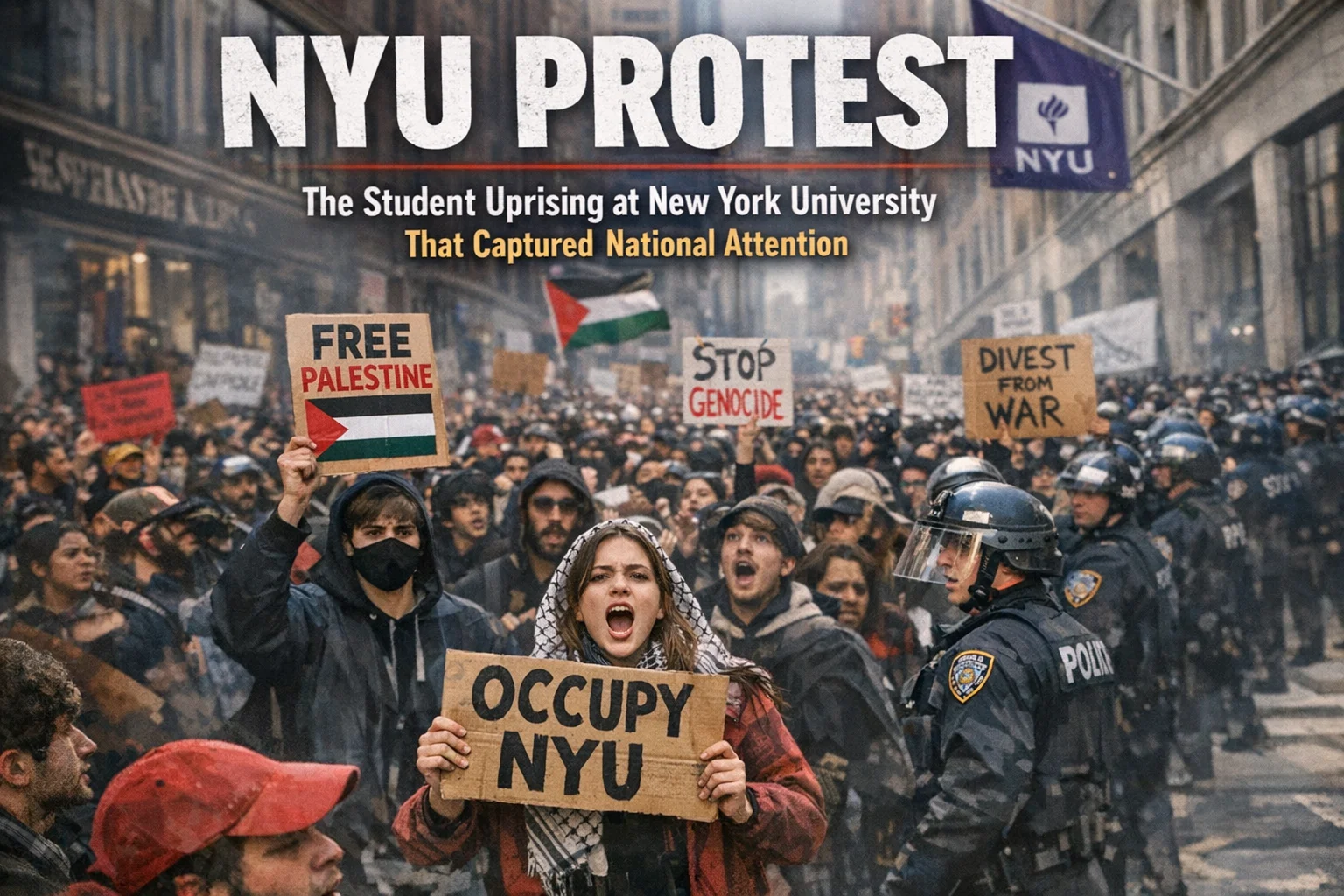
Picture this: tents popping up overnight on a bustling Manhattan plaza, chants echoing through iconic library halls, and students linking arms against what they see as institutional complicity in a far-off conflict. That’s the essence of the NYU protest, a movement that turned a prestigious university into a national flashpoint for activism, free speech debates, and calls for accountability. What started as a handful of determined voices in 2024 snowballed into years of sit-ins, suspensions, and hard-fought victories that continue to ripple through higher education.
At its core, this wave of demonstrations reflects young people’s frustration with global issues intersecting with their daily lives on campus. New York University, known for its urban vibe and international reach, became ground zero for passionate advocacy focused on the ongoing situation in Gaza. Students weren’t just shouting slogans—they were organizing, negotiating, and facing real consequences to push for change. It’s a story of idealism clashing with institutional priorities, and it shows how one university’s decisions can spark conversations far beyond its gates.
The NYU protest didn’t happen in isolation. It drew inspiration from similar actions at other schools while carving out its own path with unique tactics and persistent follow-through. From peaceful encampments to library occupations, participants emphasized nonviolence, but the responses they encountered often escalated tensions. Understanding this requires looking at the human stories, the policy battles, and the bigger picture of what it means to protest on a modern college campus today.
The Roots of Campus Activism Leading to the NYU Protest
College campuses have long been hotbeds for social change, from civil rights sit-ins in the 1960s to anti-apartheid divestment drives in the 1980s. The NYU protest builds directly on that tradition, but with a 21st-century twist powered by social media, global connectivity, and heightened awareness of international human rights. Students at NYU saw parallels between historical movements and the current calls for transparency around university investments.
What fueled the fire? Many point to the October 2023 escalation in the Middle East as a turning point. As images and reports from Gaza circulated widely, NYU students—representing diverse backgrounds including Jewish, Muslim, Arab, and international communities—began questioning their school’s financial ties. They wondered aloud: Does our tuition support companies linked to the conflict? Should a university with a global footprint take a stand? These questions weren’t abstract; they hit home for students whose friends, families, or personal values were affected.
Organizers formed coalitions drawing from groups like Students for Justice in Palestine and newer alliances such as Shut It Down NYU. Faculty joined in too, adding layers of academic credibility. The movement emphasized education over confrontation at first, holding teach-ins and distributing flyers to explain divestment—a strategy where institutions pull investments from certain industries or regions. This grassroots buildup created the momentum that exploded into visible actions, showing how quiet organizing can lead to loud statements.
The urban setting of NYU amplified everything. Unlike secluded campuses, its Washington Square location meant protests spilled into public view, attracting media, counter-demonstrators, and everyday New Yorkers. This visibility helped the cause gain traction but also invited scrutiny and criticism about disruptions to classes and daily life. In the end, these roots highlight a generation unwilling to separate their studies from real-world ethics.
Timeline of Major Events That Shaped the NYU Protest
Mapping out the sequence reveals how the NYU protest evolved from a one-day stand to a multi-year campaign. It wasn’t a single burst but a sustained effort with peaks and pushes for accountability. Early actions focused on visibility, while later ones targeted specific policies like access to facilities and exam rights.
Here’s a clear overview of the key milestones:
| Date | Event Description | Key Details | Outcome/Impact |
|---|---|---|---|
| April 22, 2024 | Gould Plaza Encampment Setup and Clearance | “Liberated zone” tents erected; NYPD in riot gear clears area after barrier breach; reports of disruptive behavior | Nearly 120-150 arrests; encampment dismantled but movement gains national spotlight |
| April 26, 2024 | Re-Establishment at Paulson Center | New tents outside another campus building after initial crackdown | Sustained pressure; solidarity with other NYC schools |
| December 11, 2024 | Bobst Library Sit-In | Flyers, banners, and 13-person occupation of admin floor demanding investment disclosure | 11 students suspended for one year starting January 2025 |
| March 4, 2025 | Law Students Bobst Sit-In | 8-hour peaceful support for previously suspended peers | Led to PNG notices for participants |
| April 29, 2025 | Law Dean’s Office Sit-In | Four-hour occupation seeking explanations for sanctions | Additional PNG designations; contract demands issued |
| May 2025 | PNG Contract Standoff | 31 law students barred; required to sign no-protest pledge for exams | Students refuse, public pressure forces university to allow exams without signing |
This table captures the progression, but each entry tells a deeper story of strategy and resilience. The April 2024 encampment, for instance, began in the early hours at Gould Plaza near the business school. Organizers aimed for a symbolic “liberated zone” complete with supplies and community rules to keep things orderly. University security quickly sealed off access, turning a peaceful gathering into a standoff. By evening, with additional supporters joining, tensions rose, prompting police intervention. Critics later debated whether the response was proportionate, especially since many involved were NYU affiliates.
Fast-forward to the December library action: during finals season, no less. Participants hung banners and distributed materials calling for meetings on endowment transparency. The university viewed it as disruptive interference, leading to blanket suspensions described by supporters as collective punishment. No individual threats were proven, yet the penalties stuck for a full year in some cases.
Then came the law school chapter in 2025. Future lawyers staged sit-ins explicitly permitted under campus conduct rules, yet faced “persona non grata” status that blocked everything from dorms to health services. The demanded contract—to renounce protest rights for exam access—sparked outrage over due process. Students held firm, and after media coverage and an open letter from hundreds, the administration backed down just before finals. They could take exams, though restrictions lingered. These events illustrate how the NYU protest adapted tactics while facing evolving administrative pushback.
Each phase built community and highlighted inconsistencies in policy application. What started as tents evolved into legal and ethical battles, proving the movement’s staying power.
What Protesters Demanded During the NYU Protest
The heart of any movement lies in its asks, and the NYU protest laid out clear, actionable goals that went beyond slogans. Topping the list was divestment: pulling university funds from companies tied to arms manufacturing or operations in the West Bank and Gaza. Students argued that as an educational institution, NYU shouldn’t profit from conflict.
Another major demand involved shutting down the NYU Tel Aviv campus, seen by critics as endorsing certain policies through its presence. They also pushed for full disclosure of the endowment’s investments—something administrators had promised in earlier talks but hadn’t fully delivered. Broader calls included a ceasefire acknowledgment and stronger protections for speech on campus, ensuring protesters wouldn’t face retaliation.
These weren’t pie-in-the-sky wishes. Organizers backed them with research on university holdings and historical precedents, like past divestments from fossil fuels or apartheid-era South Africa. They framed it as moral consistency: if NYU claims values of equity and global justice, its finances should match. Faculty and alumni amplified this through petitions signed by thousands.
Casually speaking, imagine pouring your energy into lectures while knowing your school’s money might indirectly support something you oppose. That’s the personal stake driving these demands. Protesters hosted open forums and shared data packets to educate peers, turning the NYU protest into a learning experience itself. They stressed nonviolence and inclusivity, inviting dialogue even as tensions mounted.
The demands evolved slightly over time. Early encampment focuses leaned symbolic, while 2025 sit-ins zeroed in on disciplinary fairness. This flexibility kept the movement relevant, adapting to new barriers like suspensions. Ultimately, they sought not just policy shifts but a cultural change where student voices shape institutional decisions.
NYU Administration’s Response and Challenges in Handling the Protest
University leaders faced a tough balancing act: upholding safety and operations while respecting expression rights. Official statements emphasized unauthorized actions and disruptions, noting how initial plaza gatherings affected nearby classes. They installed barriers early to contain crowds and later involved police when breaches occurred.
In one key communication, spokespeople highlighted efforts to avoid escalation, offering a one-hour window for voluntary dispersal before arrests. They also reported concerns over intimidating chants and incidents that raised community safety flags. Post-clearance, access to facilities was restricted in some cases, which critics labeled collective punishment.
As the NYU protest continued into later years, responses included formal disciplinary processes. Suspensions for library actions cited violations of conduct codes around interference with university activities. For law students, the persona non grata labels and proposed agreements aimed to limit future disruptions during sensitive periods like exams.
Administrators maintained that protests are allowed but must follow time, place, and manner rules. They pointed to successful past dialogues, like fossil fuel divestment talks, as models. Yet organizers felt negotiations stalled, with abrupt halts and external pressures from donors influencing decisions.
This back-and-forth revealed cracks in communication. Faculty groups attempted mediation but reported being sidelined. The approach drew comparisons to other schools, where some opted for dialogue over enforcement. At NYU, the mix of security measures and sanctions kept the campus functioning but at the cost of trust for many involved.
Experts in higher ed note this as a common dilemma: how to foster activism without chaos. The NYU protest tested those limits, prompting internal reviews and policy tweaks that could influence future handling of similar situations.
Police Involvement and Arrests That Marked the NYU Protest
Law enforcement’s role added drama and debate to the events. During the April 2024 plaza clearance, officers in gear moved in after warnings, breaking through linked-arm barriers to remove tents and people. Arrests numbered around 120-150, mostly for trespassing, with many released shortly after.
Supporters described the scene as peaceful until police arrival—chants, prayers, and even a nearby Passover observance disrupted by the operation. Critics countered that breaches and reported antisemitic elements justified the response. Marchers later headed to police headquarters in solidarity, turning arrests into a rallying point.
Later actions avoided mass police calls, shifting to internal discipline. But the initial intervention set a tone, fueling narratives of overreach versus necessary order. National media covered the footage extensively, amplifying the NYU protest’s reach.
In casual terms, seeing riot gear on a college plaza feels jarring for many. It raised questions about proportionality: Was it the right call for student demonstrators? Legal observers noted varying outcomes, with some summonses and few serious charges. The episode underscored how local authorities intersect with campus affairs, often escalating symbolic protests into headline news.
Lasting Impact on Students, Faculty, and Daily Campus Life
Beyond headlines, the NYU protest altered lives in tangible ways. Suspended students missed classes, internships, and milestones, facing academic setbacks that could affect careers. Law participants dealt with barred access during Ramadan or health appointments, adding personal strain.
Campus vibe shifted too. Increased security, ID checks, and restricted zones created a more guarded atmosphere. Some classes moved online or adjusted schedules to accommodate demonstrations. Faculty expressing support encountered their own restrictions, highlighting solidarity across roles.
On the positive side, the movement built communities. Participants forged bonds through shared experiences, learning organizing skills and public speaking. It sparked wider conversations on investment ethics in university settings, influencing alumni donations and board discussions.
Longer-term, it prompted reflections on mental health amid activism. Students balanced studies with advocacy, sometimes at personal cost. The NYU protest also boosted enrollment interest among socially conscious applicants while deterring others wary of disruptions.
Overall, it reshaped perceptions of NYU as a place where ideas clash openly. Daily life adapted, but the underlying questions about values persist, reminding everyone that campuses are microcosms of society.
Student and Faculty Voices Sharing Perspectives on the NYU Protest
Nothing captures the spirit like direct words from those involved. One participant reflected on the plaza events: “It was peaceful, and they responded with violence… It was not proportional to the protest.” Another noted administrative choices: “Our school isn’t doing anything to promote any sort of dialogue… If higher up people listened to the students instead of getting the police involved, it would have been resolved much better.”
Law students later shared anonymously about the contract standoff: “What we’ve seen is a complete violation of our campus norms.” A professor observed the broader clampdown: “If you take a step backward and see the walled-off campus spaces… this is a very, very exceptional violation of every kind of campus norm that we were accustomed to.”
Faculty and staff groups issued statements calling suspensions “a draconian case of collective punishment” and “guilt by association.” They argued policies should encourage “a critically engaged, activist student body” rather than hinder peaceful action.
These voices humanize the NYU protest. Students stressed unity across backgrounds, rejecting division. Faculty highlighted due process lapses, while emphasizing the movement’s educational value. Together, they paint a picture of principled stands amid pressure, inspiring others to speak up.
Comparing the NYU Protest to Other University Movements Nationwide
The NYU protest didn’t stand alone. It mirrored and connected with actions at Columbia, Yale, and beyond, where encampments demanded similar divestments. NYU’s urban edge made it more public, with quicker police responses than some ivy-covered quads.
Like Columbia’s prolonged standoffs, NYU saw arrests and negotiations. But unique elements included the Tel Aviv campus focus and law school legal angles. Fossil fuel precedents at NYU showed past successes, contrasting current resistance.
Broader waves involved hundreds of campuses, with shared tactics like liberated zones and sit-ins. Differences arose in administration styles—some universities dialogued more, others enforced strictly. The NYU protest stood out for its persistence into 2025, adapting to sanctions rather than fading.
This comparison reveals patterns: generational activism meets institutional caution. It also spotlights free speech variations, where private universities like NYU navigate different rules than public ones. Lessons from all feed ongoing national discourse on protest rights.
Legal, Disciplinary, and Ethical Questions Raised by the NYU Protest
Disciplinary codes became battlegrounds. Charges focused on disruptions, yet policies explicitly allow sit-ins. The PNG process bypassed standard timelines, raising fairness issues. Contracts demanding protest waivers clashed with constitutional protections, though private institutions have leeway.
Ethically, collective penalties versus individual accountability sparked debate. Supporters invoked due process and the “Palestine exception” to speech norms. Universities countered with operational needs during critical times.
Legally, some cases may head to courts over access rights or retaliation claims. The exam standoff resolution via public pressure set an informal precedent for accountability.
These questions extend to higher ed broadly: How much disruption is tolerable? When does advocacy cross into interference? The NYU protest forces examination of these, potentially refining policies for future generations.
The Broader Significance for Higher Education and Society
What does the NYU protest teach us? It underscores youth power in shaping narratives around global issues. In an era of information overload, physical actions cut through noise, demanding attention.
For universities, it highlights investment scrutiny’s rise. Endowments aren’t neutral; students increasingly expect alignment with stated values. This could influence governance, with more transparent reporting becoming standard.
Societally, it reflects polarized times where campus debates mirror national divides. Yet it also shows bridges: diverse coalitions forming despite differences. Media amplification helped, but also simplified complex motives.
Moving forward, the legacy encourages civic engagement. Graduates carry organizing experience into workplaces, fostering informed citizenship. The NYU protest reminds us education isn’t just classrooms—it’s wrestling with the world’s toughest questions.
Future Outlook and Lessons Learned from the NYU Protest
Looking ahead, activism at NYU shows no signs of vanishing. Recent pickets on other issues prove the spirit endures. Lessons include the value of persistence, coalition-building, and leveraging public opinion.
Administrators might prioritize early dialogue to prevent escalations. Students could refine tactics for minimal disruption while maximizing impact. Society gains from protecting protest spaces, ensuring campuses remain idea incubators.
The NYU protest ultimately models how determination meets resistance, yielding incremental wins like exam access. It inspires reflection: What role should institutions play in global ethics? As new cohorts arrive, the conversation continues, evolving with each generation.
Conclusion
In wrapping up this deep dive, the NYU protest stands as more than campus news—it’s a testament to engaged citizenship in turbulent times. From Gould Plaza to library halls, students reminded everyone that silence isn’t an option when principles are at stake. The movement sparked dialogue, faced setbacks, and secured small victories, proving change often comes through sustained effort. While challenges remain, its energy fosters hope for more accountable universities and a world where young voices drive progress. Whether you’re a student, alum, or observer, the story encourages questioning, listening, and acting thoughtfully. The NYU protest may have peaked in certain phases, but its echoes will shape campus life and beyond for years to come.
FAQ
What sparked the initial wave of the NYU protest?
The NYU protest gained momentum in April 2024 primarily through student outrage over the university’s perceived financial links to companies involved in the Gaza conflict. Organizers from various coalitions set up the first encampment at Gould Plaza to demand divestment and transparency. This followed broader global events and earlier campus discussions, turning quiet concerns into visible action as participants sought meetings with leadership that felt ignored.
How many students faced arrests or suspensions because of the NYU protest?
During the April 2024 clearance, around 120 to 150 individuals, mostly students and some faculty, were arrested at the plaza site. Later, in December 2024 and into 2025, at least 11 students received one-year suspensions for the Bobst Library sit-in, with 31 law students hit by persona non grata restrictions. These numbers reflect the escalating disciplinary approach over multiple phases of the movement.
Did the university meet any demands from the NYU protest organizers?
While full divestment or campus closure didn’t occur, partial wins emerged. The 2025 law student standoff ended with exam access granted without signing restrictive contracts after public backlash. Earlier fossil fuel precedents showed NYU has divested in response to past pressure, offering hope. Ongoing calls for investment disclosure continue influencing board conversations, though core Gaza-related asks remain points of negotiation.
What role did police play in the NYU protest events?
Officers assisted during the 2024 encampment dispersal after university requests, citing safety and unauthorized breaches. They cleared the area with arrests but weren’t involved in later indoor sit-ins, which relied on internal sanctions. This intervention drew criticism for proportionality but was defended as necessary to restore order amid reported disruptions.
How has the NYU protest affected free speech policies on campus?
The events prompted reviews of conduct rules, highlighting tensions between permitted protests like sit-ins and enforcement during disruptions. Resolutions like allowing exams without waivers reinforced expression rights through pressure. Overall, it pushed for clearer guidelines balancing safety with activism, influencing how future demonstrations are handled while protecting the activist tradition NYU values.

