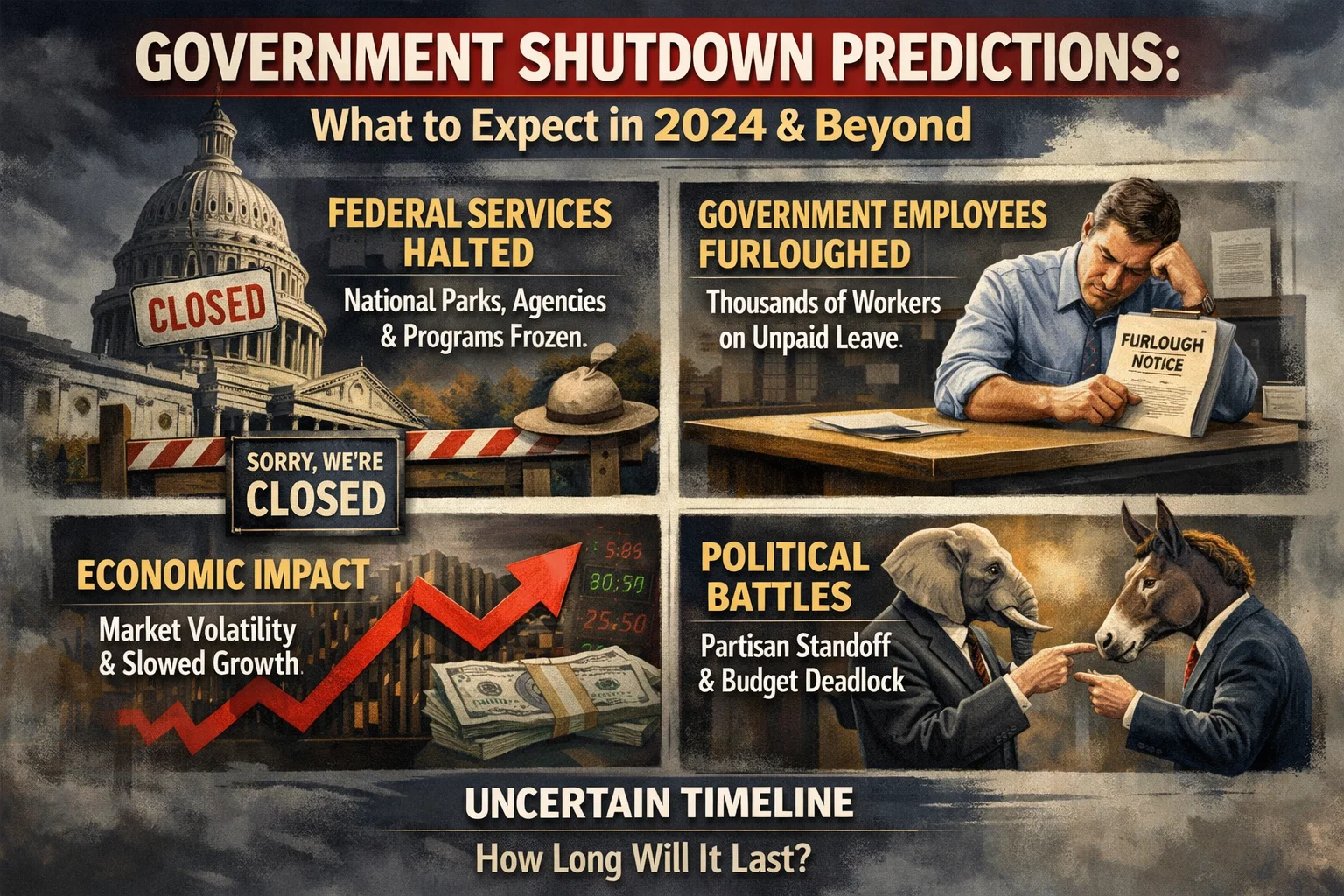
Hey there, if you’re like most folks keeping an eye on the news, you’ve probably heard the buzz about potential government shutdowns. It’s one of those topics that pops up every now and then, stirring up anxiety about everything from federal paychecks to national parks closing their gates. But let’s break it down in a way that’s straightforward and not overwhelming. Government shutdown predictions aren’t just wild guesses—they’re based on a mix of political wrangling, budget deadlines, and historical patterns. In this deep dive, we’ll explore what drives these predictions, what’s happening right now in early 2026, and how it all might play out for you and the economy.
Think about it: the U.S. government operates on a fiscal year that starts October 1, and when Congress and the President can’t agree on funding bills, things grind to a halt. We’ve seen this movie before, but each time the plot twists a bit. Right now, as of February 2026, we’re in the midst of a partial shutdown that kicked off on January 31, and experts are weighing in on how long it might last. Whether you’re a federal worker, a business owner, or just someone curious about how Washington works (or doesn’t), understanding government shutdown predictions can help you navigate the uncertainty. We’ll cover the basics, the history, and even some tips on preparation, all while keeping things real and relatable.
What Causes Government Shutdowns?
Government shutdowns don’t just happen out of the blue—they’re the result of deep-seated disagreements in Congress and sometimes with the White House. At the core, it’s about money: the federal budget needs approval through appropriations bills, and if those aren’t passed by the deadline, non-essential services stop. Often, these stalemates tie into bigger policy fights, like healthcare subsidies or immigration enforcement. For instance, the recent partial shutdown in January 2026 stemmed from partisan clashes over funding for the Department of Homeland Security, fueled by controversies around immigration agents’ actions. It’s not just about dollars; it’s about leveraging the budget to push agendas.
Beyond politics, timing plays a huge role. Continuing resolutions (CRs) are short-term fixes to keep things running, but they’re like band-aids on a bigger wound. When negotiations drag on, as they did leading up to the 2025 shutdown that lasted a record 43 days, the risk skyrockets. Economic pressures, like inflation or recession fears, can amplify these tensions, making lawmakers dig in their heels. And let’s not forget the human element—elections, public opinion polls, and even personal rivalries between leaders can tip the scales toward a shutdown.
Another key factor is the Antideficiency Act, which basically says the government can’t spend money it hasn’t been authorized to spend. This law, beefed up in the 1980s, turned funding gaps into full-blown shutdowns. Before that, agencies might limp along, but now, it’s all or nothing for non-essential operations. Policy riders—those sneaky add-ons to bills that tackle unrelated issues like abortion or environmental regs—often spark the fireworks. When one party controls the House, Senate, or White House, it can use shutdown threats as bargaining chips, but it backfires if public backlash builds.
A Look Back at Historical Government Shutdowns
Diving into history helps us make better government shutdown predictions today. Since the 1980s, when shutdowns became a real thing thanks to legal opinions from Attorney General Benjamin Civiletti, we’ve had over 20 instances where the government partially or fully closed shop. The early ones in the Reagan era were short, lasting just days over issues like civil rights funding. But they set the stage for bigger dramas.
Take the 1995-1996 shutdowns under President Clinton and a Republican-led Congress—they shut down twice for a total of 26 days over spending cuts and Medicare reforms. Hundreds of thousands of workers were furloughed, and it cost the economy billions. Fast forward to 2013, when the Obama administration faced a 16-day shutdown tied to Obamacare funding. National parks closed, and GDP took a hit. Then there’s the 2018-2019 partial shutdown, lasting 35 days over border wall money, and the 2025 whopper at 43 days due to ACA subsidy disputes. Each one shows how shutdowns evolve from budget basics to high-stakes policy battles.
| Shutdown Period | Duration (Days) | Main Cause | Key Impacts |
|---|---|---|---|
| 1980 | 1 | FTC Funding | Minimal, first modern shutdown |
| 1995-1996 (First) | 5 | Budget Disagreements | 800,000 furloughed, parks closed |
| 1995-1996 (Second) | 21 | Spending Cuts | $1.4 billion cost, GDP loss |
| 2013 | 16 | Obamacare Funding | $24 billion economic hit |
| 2018-2019 | 35 | Border Wall | Longest at time, $11 billion loss |
| 2025 | 43 | ACA Subsidies | Record length, $11 billion GDP loss |
This table highlights how durations and causes have varied, but the fallout—furloughs, delayed services, economic drags—remains consistent. Learning from these can sharpen our government shutdown predictions, showing patterns like increased frequency in divided governments.
Current Landscape: Government Shutdown Predictions for Early 2026
As we sit here in February 2026, government shutdown predictions are buzzing with the ongoing partial shutdown that started January 31. Betting markets like Kalshi and Polymarket pegged the odds at over 90% for a 2026 shutdown, and boy, were they right. This one’s partial, hitting agencies like DHS, DOD, and HHS, but experts say it could wrap up soon with the House voting Monday. The trigger? Heated debates over ICE reforms after high-profile incidents. If it drags, we might see broader effects, but for now, it’s expected to be brief.
Looking ahead, government shutdown predictions for the rest of 2026 hinge on fiscal deadlines. The next big one could be around September, when FY2027 funding kicks in. With Republicans controlling Congress and the White House, unity might prevent full meltdowns, but internal rifts—think Freedom Caucus vs. moderates—could spark threats. Economists like those at Goldman Sachs warn that prolonged ones could shave GDP growth, but short stints are more annoyance than apocalypse.
Predictions also factor in external shocks, like economic slowdowns or global events, which could force hasty deals or extend impasses. Pollsters note public fatigue with shutdowns, which might pressure lawmakers to compromise faster. Overall, while 2026 started with a bang, smarter budgeting could keep things smoother later in the year.
Key Factors Influencing Current Government Shutdown Predictions
When making government shutdown predictions, several factors come into play. First up is partisan control: unified government reduces risks, but even then, as in 2026, policy hot potatoes like immigration can derail things. Debt ceiling debates often overlap, adding fuel to the fire—remember how they intertwined in past crises?
Economic conditions matter too. In a strong economy, lawmakers might risk shutdowns for leverage, but during slumps, like post-pandemic recoveries, they’re more cautious to avoid GDP hits. Public sentiment is a wildcard; polls showing blame on one party can force concessions. For 2026, betting odds reflected this, spiking after key events like the Minneapolis shootings.
Leadership styles influence predictions. A president like Trump, known for hardball tactics, ups the ante. Meanwhile, proposals like automatic CRs could change the game, making shutdowns rarer. All these elements weave together for informed government shutdown predictions.
Economic Ramifications of Government Shutdowns
Government shutdowns pack an economic punch, even if short-lived. The CBO estimates a six-week shutdown like in 2025 costs $11 billion in lost GDP, with some never recovered. Furloughed workers miss paychecks, curbing spending in local economies—think restaurants near D.C. taking hits. Contractors face delays, and user fees go uncollected, adding to the tab.
Longer shutdowns amplify issues: private investment stalls as businesses await permits, and consumer confidence dips. The 2018-2019 one cost $11 billion overall, per CBO. But rebounds happen; backpay boosts later quarters. Still, indirect costs—like tourism losses at national parks—are real and lingering.
For 2026’s partial shutdown, experts like Mark Zandi say minimal damage if brief, but prolonged could dent growth by 0.1% weekly. Small businesses suffer most, missing SBA loans. Overall, shutdowns highlight budgeting flaws, costing more than they save.
How Government Shutdowns Affect Everyday Americans
It’s not just abstract numbers—government shutdowns hit home for millions. Federal workers, about 800,000 in big ones, face furloughs without pay, scrambling for bills. Families reliant on SNAP or Head Start see disruptions; in 2025, nearly 10,000 kids lost childcare. Travelers deal with longer airport lines as TSA staff thins.
Veterans’ services, tax refunds, and even beer approvals slow. Small towns near federal lands suffer tourism drops. But essential services like Social Security payments continue, offering some relief. The psychological toll? Stress and uncertainty ripple out, affecting mental health.
In 2026’s shutdown, DHS focus means immigration processing halts, impacting families and businesses. It’s a reminder that shutdowns aren’t just political theater—they disrupt real lives.
Expert Insights on Government Shutdown Predictions
Experts offer valuable takes on government shutdown predictions. Mark Zandi from Moody’s says short shutdowns have “no upside” but marginal downsides, mainly from furloughs. “If it drags on, economic damage mounts,” he notes.
Political analyst David Karol points to Senate rules allowing delays, predicting a quick end to 2026’s impasse but warning of DHS-specific extensions. CBO’s projections highlight GDP losses, estimating $11 billion unrecovered for six weeks.
Maya MacGuineas of CRFB advocates for auto-CRs to end drama: “It’s time to prevent these costly games.” These views shape reliable government shutdown predictions.
Preparing for Potential Government Shutdowns
If government shutdown predictions worry you, preparation helps. Federal employees: build an emergency fund covering 1-2 months’ expenses. Diversify income if possible.
Businesses: review contracts for shutdown clauses, stock up on essentials. Individuals: file taxes early, renew passports ahead. Stay informed via OPM updates.
Community support: food banks, credit unions offer aid during shutdowns. Long-term, vote for budget reformers.
The Political Dynamics Behind Shutdown Threats
Shutdown threats often stem from power plays. In divided Congress, they’re leverage tools. But in unified ones, like now, internal party fights emerge.
Media amplifies drama, influencing public blame. For 2026, Democrats’ DHS demands highlight immigration’s role. Understanding this aids predictions.
Long-Term Solutions to Avoid Future Shutdowns
To dodge future shutdowns, reforms like auto-CRs are key. Biennial budgeting could ease pressure.
Bipartisan commissions might depoliticize processes. Public pressure for on-time budgets matters.
conclusion
government shutdown predictions point to ongoing risks, but with history as a guide and reforms on the horizon, we can hope for smoother sailing. These events remind us of democracy’s messiness, but also its resilience. Stay engaged, and let’s push for better.
FAQ
What are the latest government shutdown predictions for 2026?
As of February 2026, the partial shutdown is likely short, ending soon with House action. But watch for September FY2027 risks if divisions persist. Experts predict fewer if auto-CRs pass.
How do government shutdown predictions impact the stock market?
Predictions can cause volatility, with prolonged ones hurting confidence. Short ones have minimal effects, per economists.
What historical data informs government shutdown predictions?
Past shutdowns like 1995-1996 and 2025 show policy ties and economic costs, aiding forecasts.
Can government shutdown predictions be accurate?
Yes, using betting markets and expert analysis, like Kalshi’s 94% odds for 2026.
How do global events affect government shutdown predictions?
They can force unity or heighten tensions, influencing U.S. budget talks.
Why do government shutdown predictions often involve immigration?
It’s a hot-button issue, as in 2026’s DHS funding fight.